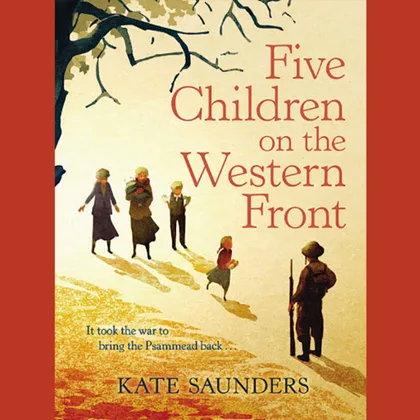
Five Children on the Western Front
Author Kate Saunders
-
Story
Five Children on the Western Front takes inspiration from E Nesbit’s novel Five Children and It, the story of five children who meet a magical creature called the Psammead. It had occurred to Kate Saunders that the children in the original novel were just the right age to find themselves in the trenches in the First World War. In her story nine years have passed when the Psammead comes back into the lives of the five siblings from the original novel, Anthea, Robert, Jane, Cyril and Lamb, and their younger sister, Edie. It is 1914 and Cyril is just about to leave for the war.
Psammead’s presence brings hope of new adventures for the children, but it also helps the family understand the raging war. Before the story comes to an end, Lamb and Edie will have seen the First World War from every possible viewpoint.
-
Why we chose it
A story that is both homage to a classic story, E Nesbit’s Five Children and It, and a moving portrayal of how the first World War changed the lives of one family.
-
First published
2014, Faber & Faber, London, UK
Story Reviews
Our reviews come from a team of young story lovers! If you’re aged 8–16 and keen to join in, learn how to become a reviewer for The Story Museum.
Five Children on the Western Front (Kate Saunders) was written as a follow-up to E. Nesbit’s trilogy which began with the iconic Five Children and It, I initially had my doubts about this book, as I had heard that it was very different from the original books (which I really liked). I found that it was actually quite interesting to see how the characters has changed as they got older. Since, as the name suggests, it was set during World War One, the author has taken a more “realistic” approach, with two characters being sent off to fight, and the Psammead turning out to have a morally questionable past. I’m not sure what I thought of this change of view - in some ways it gave it a new layer of interest, but in others it marred the childish outlook of the original books. I also thought it ended somewhat abruptly, but despite this it was well-written and quite emotional. I would probably recommend this, but I think it is important to know before reading that it is very different to E. Nesbit’s books.