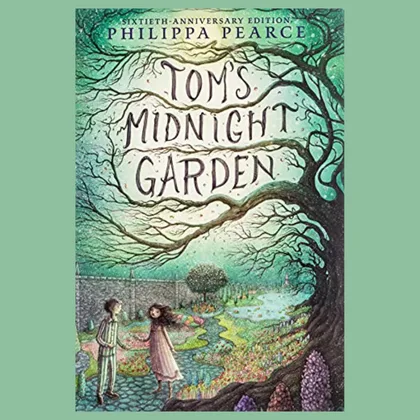
Tom's Midnight Garden
Author Philippa Pearce
-
Story
When his brother contracts the measles, Tom is sent to his aunt and uncle, who live in a city flat. The building was once a Victorian mansion, but its grounds are now occupied by modern houses. At night however, the clock strikes 13, and the back door leads Tom into a garden of a time long past.
-
Why we chose it
Tom’s Midnight Garden is a classic children’s novel – a beautiful, haunting time slip story about loneliness, friendship and growing up.
-
What a young reviewer said
A wonderfully imaginative and thought-provoking story. The book blends fantasy with reality in a way that feels both magical and believable. Its emotional depth, originality, and timeless message make it a classic worth reading. (Zakia, age 13)
-
First published
1958, Oxford University Press
Story Reviews
Our reviews come from a team of young story lovers! If you’re aged 8–16 and keen to join in, learn how to become a reviewer for The Story Museum.
The story begins when Tom, a boy in quarantine when his brother has measles, is sent to stay with his dull aunt and uncle in an old house. At first, Tom feels frustrated and trapped—he misses his brother, finds his relatives boring, and thinks the house has nothing to do. Everything changes when he is unable to sleep one night, he hears the old grandfather clock strike thirteen. Curious, he creeps downstairs and opens the back door, expecting to see a paved yard, but instead discovers a vast, magical garden that seems to belong to another era entirely. Each night at midnight, the garden reappears, and Tom explores its lawns, orchards, and riverbanks, slowly realizing that he has stumbled into a world that exists outside of ordinary time. There he meets Hatty, a young Victorian girl who at first sees him as a playmate but gradually grows into a companion whose life moves forward much more quickly than Tom’s nightly visits. Their adventures—skating on a frozen river, climbing trees, making a treehouse, and racing through the garden—become both thrilling escapes for Tom and important moments of connection for Hatty, whose own childhood is marked by loneliness and loss. This book is a wonderfully imaginative and thought-provoking story. The writing is rich and descriptive, which creates a vivid picture of the midnight garden and draws the reader into its magical atmosphere. However, at times the story moves quite slowly, with long descriptive passages. Despite this, the slower pace also allows for deeper reflection on the themes of time, memory, and change, which are what give the novel its emotional weight. The relationship between Tom and Hatty is beautifully developed, moving from playful companionship to an important aspect of growing up and moving on. I also liked how the book blends fantasy with reality in a way that feels both magical and believable. The story’s gentle style and gradual unfolding may not engage every reader equally. Still, its emotional depth, originality, and timeless message make it a classic worth reading.